
title: Apple Is Now Training AI Specifically for the Chinese Market: Why Global Companies Need a "Localized AI Website"
lang: zh-CN
published_at: 2026-08-19
reading_time: 12-15 minutes
estimated_length: Approximately 3,800 characters (Chinese main text ~3,100 characters; English main text ~2,600 words)
tags: Apple Intelligence, Localized AI, Global Companies, AI Website, SEO, GEO, Going Global, We0 AI
seo_title: Apple Is Training AI for the Chinese Market—Why Global Companies Need a Localized AI Website
seo_description: Apple's move to train a dedicated AI for the Chinese market shows that going global is no longer just about translating your website. Companies need to localize models, content, compliance, SEO, GEO, and customer acquisition paths together.
seo_keywords: Localized AI website, Global website, Apple China AI, Apple Intelligence China, AI website localization, localized AI website, international SEO, GEO, going global website, multilingual website
seo_slug: apple-localized-ai-website-global-companies
seo_cover_brief: A premium editorial illustration of a global smartphone product connecting to a China-specific AI model and a localized website gateway. Black, cobalt blue and red accents, 16:9, minimal, no readable text.

The Bottom Line First: Localization Has Shifted from "Translating Pages" to "Rebuilding the Intelligent Gateway"
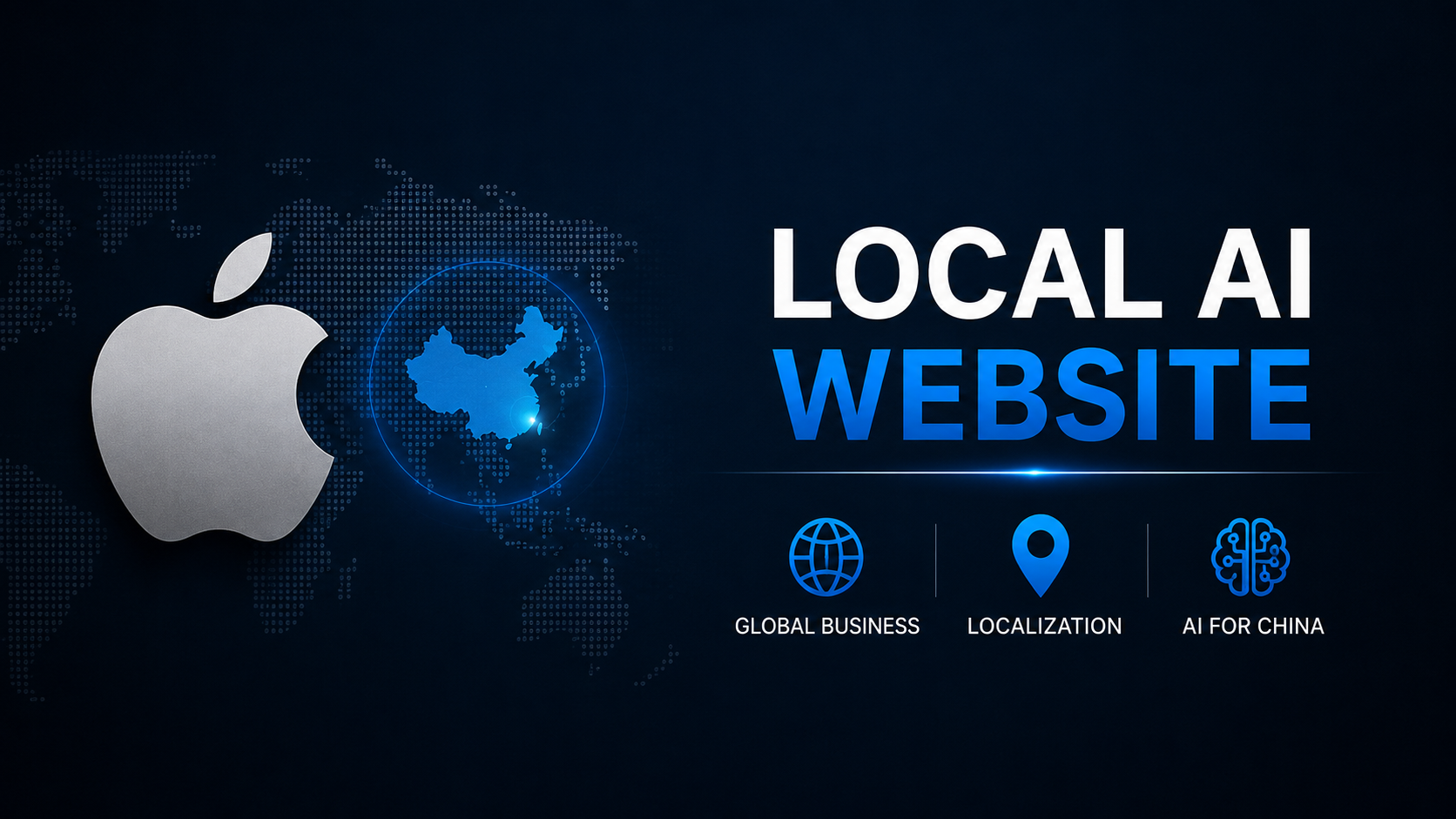
According to a Reuters report on August 14, 2026, Apple has trained a large language model specifically for the Chinese market, developed with support from Alibaba. The most notable aspect of this news isn't that Apple has trained yet another model.
It's the very practical signal it sends: When a global product enters a key market, even the model layer may need localization—so a website certainly can't be handled by simply translating an English page.
In the past, many companies understood "going global with a website" roughly like this:
- Build an English website;
- Translate the navigation and core copy into Chinese, Japanese, or Spanish;
- Switch to a local domain;
- Integrate local payment or customer service channels.
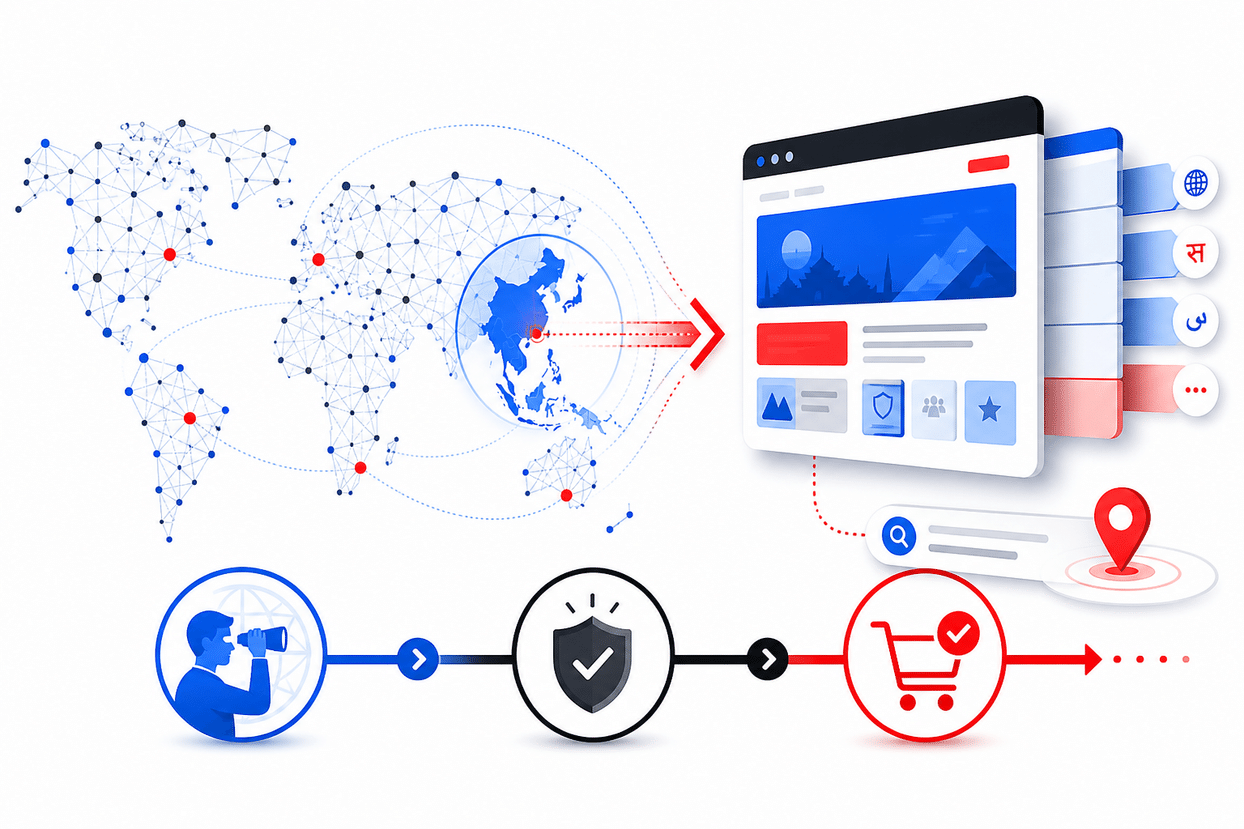
These things are still useful. But now that AI search, answer engines, and local models participate in decision-making, what users see is no longer just a page—it's a digital experience composed of models, content, search entry points, trust signals, and conversion paths working together.
A localized AI website is not "just another language version"—it's about ensuring the same brand is correctly understood, correctly retrieved, correctly recommended, and ultimately able to drive business in different markets.

What Exactly Did Apple Do This Time? Let's Clarify the Facts First
Public information available so far can piece together a relatively clear timeline.
In February 2025, Alibaba's board chairman Joe Tsai confirmed that Apple would use Alibaba's AI to power iPhones in the Chinese market. After that, the rollout of Apple Intelligence in China went through a lengthy adaptation and regulatory review process.
In July 2026, media reported that the China version of Apple Intelligence had completed the relevant generative AI service filing. Reports also noted that Apple Intelligence adapted for the Chinese market plans to integrate Alibaba's Tongyi Qianwen capabilities, and had previously involved Baidu-related technologies as well.
By August 2026, Reuters, citing three sources familiar with the matter, reported that Apple had further trained a proprietary large language model targeting the Chinese market, with Alibaba supporting the training.
There are three details that can't be glossed over:
- "Apple trained a China-specific model" is a media report citing informed sources, not an official, complete technical disclosure from Apple.
- How this model will coordinate with local models like Tongyi Qianwen and Baidu has not been fully answered by public information.
- The specific launch timeline, device coverage, and feature boundaries of Apple Intelligence in China may still shift with system updates and regulatory progress.
This actually makes the case more valuable. It shows that localization isn't a packaging move for a keynote—it's a continuous engineering effort spanning partners, data, models, features, compliance, and user experience.
Why Can't Global Products Rely on a Single AI?
- The "Right Answer" to the Same Question Can Differ Across Markets
When users ask "how to start a company," "how to integrate payments," "what data can be used for training," or "when will a service be available," the answers aren't determined by language alone—they're shaped by laws, industry practices, platform ecosystems, payment methods, content regulations, and local business processes.
Applying a global model's answers directly to a local market can produce three types of problems:
| Problem | Surface Manifestation | Real Loss |
|---|---|---|
| Wrong context | Words are translated correctly, but users feel it's not a local product | Declining trust |
| Inapplicable information | Recommends tools or processes that aren't usable locally | Declining experience and conversion |
| Uncontrolled risk | Ignores regulatory, privacy, or industry constraints | Delayed launch, or failure to launch at all |
So, AI localization is first about localizing knowledge and judgment, and only secondarily about localizing language.
- The Model Itself May Not Need to Be Completely Different, but the Website Must Be
Many companies misunderstand this: Does localization mean retraining a full large language model for every country? It's usually not that simple—and not necessary.
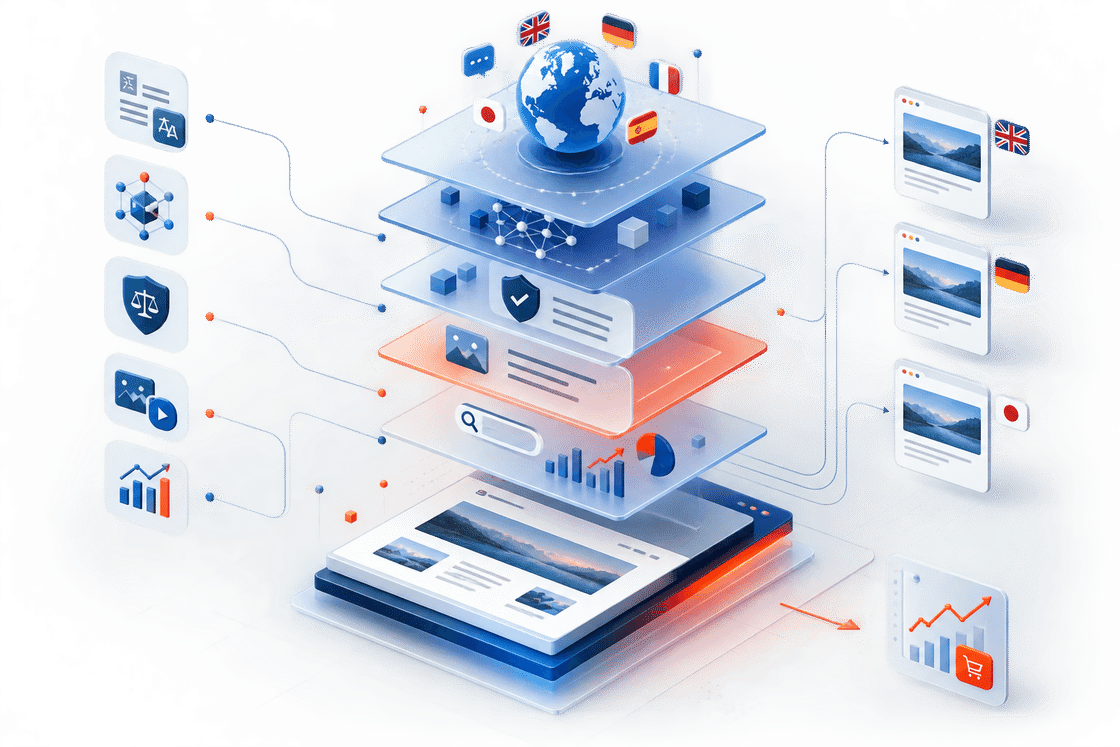
A more practical approach is to break localization into layers:
- Foundation model layer: Handles general understanding and generation capability;
- Data and knowledge layer: Adds local product, regulatory, industry, and customer context;
- Reasoning and safety layer: Handles compliance, privacy, and risk boundaries;
- Experience layer: Determines how users ask questions, receive results, and take next steps;
- Website and content layer: Ensures search engines, AI engines, and real users can all find and understand these capabilities.
Companies can share a single global brand and technology foundation, but they cannot share an unadjusted market gateway.
The website is that market gateway. It's responsible for clearly communicating "who we are, who we serve, where we're available, what problems we solve, and why we're trustworthy"—and for making that information readable by traditional search and AI answer engines.
A Truly Localized AI Website Needs Localization at Five Layers
If "localizing a website" only changes the language, it often stays on the surface. A more complete framework treats the website as a five-layer system.
Layer 1: Language Localization
This isn't just translating "AI website builder" into another language. It also includes headline phrasing, search terms, product categorization, button wording, FAQ expression, and the narrative style of customer stories.
How Chinese users search for "AI 官网生成," "出海官网," or "GEO 优化" is different from how American users search for "AI website builder," "international SEO," or "AI search visibility." The same product needs to be discoverable through the language each market actually searches in.
Layer 2: Content Localization
The proof users want to see differs.
Customers in mature markets may care more about security certifications, integration ecosystems, and service levels; customers in another market may care more about local payment methods, delivery timelines, after-sales support, compliance details, and real case studies.
So the localized website should not be a copy of the global site; it should answer the specific questions local customers have:
- Are you available in this market?
- How are data and privacy handled?
- Are there local customers or case studies from similar industries?
- Can you integrate with tools commonly used locally?
- How do purchasing, delivery, customer support, and refunds work?
Layer 3: Model and Knowledge Localization
This is where the Apple case is most striking. When a model needs to be trained or adapted for different markets, the website must also explain the capability boundaries accordingly.
Otherwise, users face an awkward situation: the product is already localized internally, but the website still only speaks about itself in the global version's language. Search engines can't understand it, AI engines can't crawl it, and users can't tell which features are actually available.
Layer 4: Discovery Method Localization
In the past, website SEO mainly revolved around Google, Bing, or local search engines. Now you also need to account for AI Q&A and generative search: they extract answers from page titles, structured data, body entities, FAQs, case studies, and external references.
This is the real part of GEO: not stuffing a few keywords into pages, but making the site a knowledge source that is clearly structured, factually explicit, easy to cite, and continuously updated.
Layer 5: Conversion Path Localization
Users in different markets have different trust paths. Some book a demo first, some check pricing first, some download a whitepaper first, and some need WhatsApp, WeChat, email, or local forms.
If the website only does language translation without adjusting CTAs, form fields, sales handoff, and support entry points, it's just "understandable," not yet "closing deals."
Don't Make "Localized AI Website" an Isolated Project
The problem for many global companies isn't a lack of localization awareness—it's that localization is broken into siloed projects: marketing changes copy, product changes features, legal reviews compliance, sales builds its own materials, and SEO is only notified at the end to "translate the page."
This workflow easily creates gaps: the product already supports local capabilities, but the website hasn't been updated; marketing has launched campaigns, but the landing page lacks local case studies; sales has captured leads, but forms still ask questions that don't fit local users.
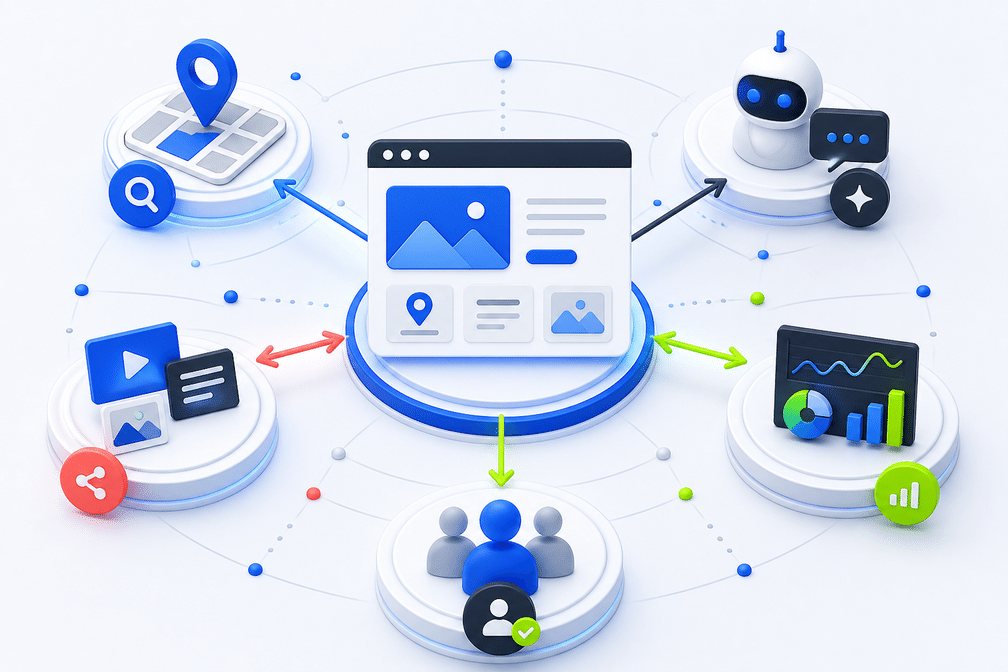
A localized AI website should be a continuous chain from Build to Showcase, then to Grow and Leads.
How Can Global Companies Build This Kind of Website?
Step 1: Start with a Market and User Intent Map
Don't start with "how many languages do we have," but with "what will users in this market ask."
Start by listing four types of search intent:
| Search Intent | What Users Really Want to Confirm | What the Website Should Prepare |
|---|---|---|
| Informational | Who you are, what the product does | Local-language homepage, product pages, brand explanation |
| Comparative | How you differ from local alternatives | Comparison pages, feature matrix, case studies, pricing |
| Problem-solving | Whether you can solve my specific business problem | Scenario pages, industry pages, FAQ, templates |
| Transactional | How do I try, buy, or contact you now | Local CTAs, forms, demos, support entry points |
Build a showcase site and grow leads in minutes
Describe your idea once, and We0 AI can generate a showcase site, pages, and CMS, then help you attract customers and traffic after launch.
One complete project generation for free registration
Best for trying one complete generation flow and seeing a first project draft quickly.
This step determines whether the site is a "translation site" or a "market answer library."
Step 2: Build Regional Information Architecture Instead of Copying Global Navigation
The global site may be organized by Product, Solutions, Resources, and Company; the local market may need organization by industry, use case, pricing, service model, or compliance issues.
Of course, not every market needs a complete rebuild. A good approach is to keep the brand backbone and adjust local branches:
- Keep consistent brand name, core visuals, and product boundaries;
- Add industry pages, case studies, and local FAQ sections for the market;
- Clearly state unavailable features so users don't have to guess;
- Give local search terms their own dedicated pages rather than cramming everything into the homepage;
- Allow local content to be continuously published, revised, and reviewed.
Localization isn't about breaking the global brand—it's about restoring clarity to the global brand in a local context.
Step 3: Make AI Search Understand Your Business
AI search prefers clear entity relationships over pretty but empty design.
At minimum, each page should clearly state:
- The standard names of the company and product;
- The problems the product solves;
- The target users and available regions;
- Core features, limitations, and integration methods;
- Pricing, delivery, support, and security details;
- Customer cases, authors, or expert information;
- Internal links between related pages.
On the technical side, you need language tags, canonical links, structured data, sitemaps, page performance, and crawlability. On the content side, you need to continuously publish articles that answer real questions, not just company news.
Step 4: Make the Localized Website Sustainable
This is the step many projects overlook most.
A localized website may look complete on launch day, but that doesn't mean it will still be effective three months later. Market policies change, product capabilities change, search questions change, and competitors change. You need to know which pages are getting traffic, which pages are cited by AI, which keywords are generating leads, and which form fields are causing user drop-off.
So the website system should at least support:
- Content editing and version updates;
- Multi-language page management;
- SEO metadata and structured content maintenance;
- Quick publishing of local cases, products, and FAQs;
- Traffic and conversion data monitoring;
- Ongoing optimization of page performance and CTAs.
A localized website isn't a one-time translation delivery—it's an ongoing growth effort.
Why We0 AI Is Suited for This Kind of Need?
If a company just wants a temporary campaign page, any page generator might be enough. But what global companies typically need isn't a pretty page—it's a display website that can truly go live, be managed, and grow continuously.
We0 AI's positioning goes beyond an ordinary AI website builder. It brings requirement understanding, page planning, visual design, code generation, CMS, SEO/GEO, domain binding, and launch delivery into a single workflow.
This means a company can start by describing a market goal:
We want to enter a certain market, serve a certain type of customer, and need a local-language website that explains the product, showcases case studies, handles demo bookings, and continuously earns search and AI-recommended traffic.
From there, the website shouldn't stop at "generating a homepage." It also needs to continue:
- Organizing brand information into a clear site structure;
Generate product pages, scenario pages, comparison pages, and FAQs for different user intents;
- Manage continuously updated content through CMS;
- Set up foundational SEO and GEO configurations;
- Bind a domain and actually publish;
- Keep optimizing based on traffic and conversion data.
This is where We0 AI is better suited for showcase website growth: Build -> Showcase -> Grow -> Leads.
It doesn't just help you "have a website" — it helps you turn your website into a long-term asset for brand showcasing, content accumulation, search discovery, and customer acquisition.
One Table to Understand: Ordinary Multilingual Website vs. Localized AI Website
| Dimension | Ordinary Multilingual Website | Localized AI Website |
|---|---|---|
| Core Goal | Make users understand | Make users discover, understand, and act |
| Content Approach | Translate global copy | Rewrite around local questions, cases, and context |
| AI Relationship | Put an AI feature on the page | Coordinate model, content, compliance, and entry points |
| SEO | Translate keywords | Redo search intent, page structure, and entity relationships |
| GEO | Basically not considered | Make it easier for AI engines to extract and cite |
| Conversion | Unified CTA | Design forms, support, and sales handoff based on local market habits |
| Operations | Rarely updated after launch | Continuously publish, monitor, review, and optimize |
The difference isn't whether the pages are multilingual — it's whether they truly participate in local growth.
What Does This Mean for Global Teams?
If You Build SaaS or AI Products
Don't just translate the product homepage. Prioritize the feature pages, industry pages, alternative pages, and integration pages that local users are most likely to search for. AI products especially need to explain data handling, available regions, model capabilities, and limitations.
If You're an Indie Developer or Small Team
You don't need to build ten completely different systems for ten countries from day one. Pick one market with clear demand, and get one localized website fully running: pages, content, case studies, forms, data — then replicate the playbook.
If You Do Foreign Trade or Cross-Border Services
"We serve global customers" is not localized content. What users really want to see is: Have you worked with companies like theirs? How is delivery handled? Can you communicate in their language? Who do they contact when something goes wrong?
If You Have Multiple Regional Markets
You need to manage language versions, regional pages, domains, analytics data, and content permissions. Otherwise, as page count grows, duplicate content, broken links, and outdated pricing will pile up together.
FAQs
What is a localized AI website?
A localized AI website is a site redesigned around the target market's language, search intent, regulatory environment, user trust habits, AI capabilities, and conversion paths. It is not the same as translating a global website into a local language.
What does Apple training AI for the China market have to do with corporate websites?
It shows that global products may need different models, knowledge, compliance approaches, and user experiences in different markets. The website is the primary entry point through which users, search engines, and AI answer engines understand these localized capabilities — so it needs to be localized in sync.
Does a localized website require retraining a large model?
Not necessarily. What many companies need more is a local knowledge base, content structure, retrieval strategy, compliance documentation, and regional experience optimization. Whether to train or adapt a model depends on product risk, user scale, data requirements, and market constraints.
What's the difference between a multilingual website and a localized website?
A multilingual website solves "readability." A localized website goes further to solve "findability, trustworthiness, usability, and willingness to act." The latter adjusts content, structure, case studies, SEO/GEO, and conversion paths.
Which pages should a localized AI website start with?
Typically you can start with the localized homepage, core product pages, industry/scenario pages, comparison pages, case study pages, FAQs, and contact/demo pages. The page order should be determined by real search intent and business priorities.
Related Tools
- We0 AI AI Website Builder: Generate a launch-ready website from natural language requirements.
- We0 AI SEO and GEO Optimization: Optimize search-friendly structure, metadata, structured data, and AI comprehensibility.
- We0 AI CMS Backend: Manage products, case studies, articles, FAQs, and multilingual content.
- We0 AI Domain Deployment: Complete domain binding and website publishing.
- We0 AI Growth Workspace: Keep operating the website around content, traffic, and conversion.
References
- Reuters: Apple trains its own AI model for China market with Alibaba's support
- The Business Standard: Apple trains its own AI model for China market
- Cailian Press: Apple reportedly trained a "China-customized" large model
- Apple Intelligence Official Introduction
- We0 AI About Us
Ready to Start?
If your team is entering a new market, don't rush to ask "can we just translate the existing website?" A better set of questions is:
- How will local customers search for us?
- How will AI engines understand us?
- Which product capabilities are actually available locally?
- What evidence do users need before leaving a lead?
- Can we keep updating and optimizing this website?
We0 AI can help you get started with requirement mapping, page planning, and website generation — bringing local content, CMS, SEO/GEO, launch, and continuous growth into one workflow.
Start building your global showcase website
Summary
Apple's news about training a dedicated AI for the China market is a real reminder for global companies — not "every country needs its own model."
It reminds us that: local competition for global products is shifting from feature adaptation to intelligent entry-point adaptation.
Models need to understand local context, products need to comply with local rules, content needs to answer local questions, and websites need to make the brand accurately understood by both local users and AI engines.
So, a website that can simply translate is no longer enough. What you need is a localized AI website that can showcase, be discovered, be continuously operated, and generate leads.
That's the value of We0 AI: not just building pages, but helping companies turn their websites into long-term growth and lead-generation assets.
edition
tags: Apple Intelligence, localized AI, global companies, AI website, SEO, GEO, international growth, We0 AI
seo_title: Apple Is Training AI for China. Why Global Companies Need a Localized AI Website
seo_description: Apple’s China-specific AI model shows why global expansion is no longer just website translation. Companies need to localize models, content, compliance, SEO, GEO and conversion paths together.
seo_keywords: localized AI website, AI website localization, Apple Intelligence China, international SEO, GEO, global website strategy, China AI model, cross-border website, AI website builder, We0 AI
seo_slug: apple-localized-ai-website-global-companies
seo_cover_brief: A premium editorial illustration of a global smartphone product connecting to a China-specific AI model and a localized website gateway. Black, cobalt blue and red accents, 16:9, minimal, no readable text.