
Bottom line: Yes, you need it — and you need it more than ever.
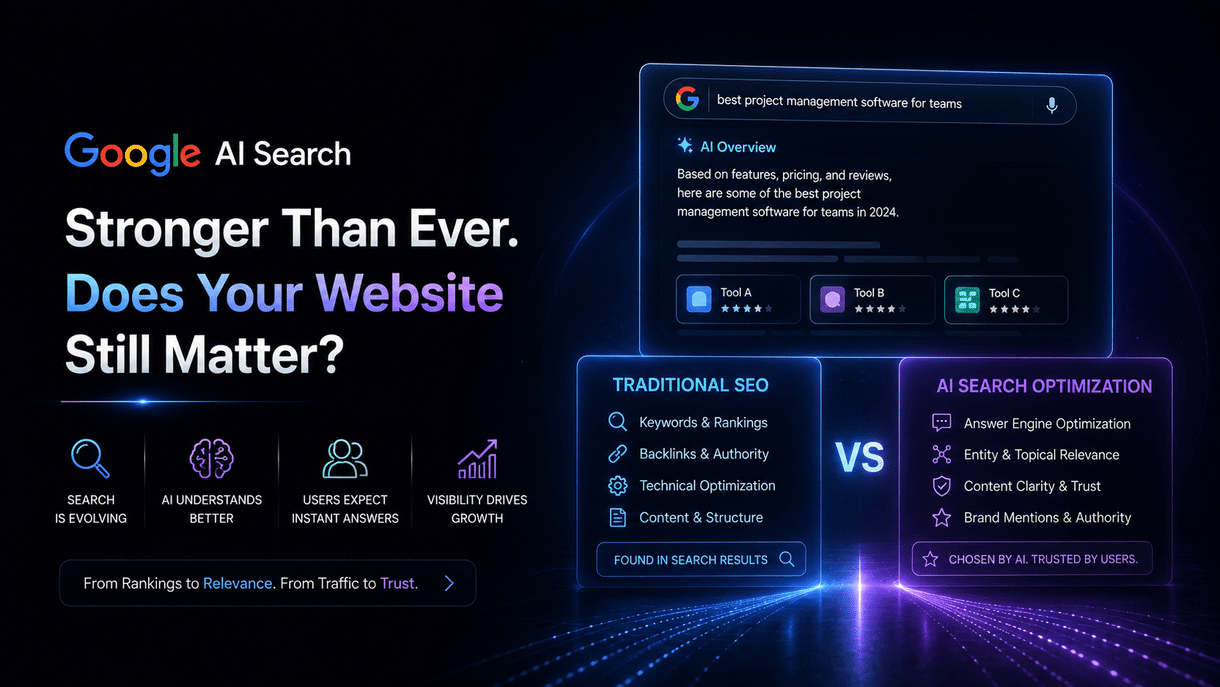
If you interpret "traditional SEO" as merely tracking rankings, stuffing keywords, and publishing dozens of low-quality articles, then yes, it's becoming obsolete. But if you understand SEO as a systematic effort to make your corporate website "continuously discovered, understood, referenced, trusted, and converted," then after Google AI Search got stronger, it not only hasn't gone out of date — it has become an even more foundational layer of your company's digital assets.
The reason isn't complicated. Google has officially confirmed that AI Overviews and AI Mode will still display supporting links. And for a page to appear in these AI search features, the prerequisite remains that the page can be indexed, meets Google Search technical requirements, and follows people-first content best practices. In other words, AI search is not a replacement for SEO — it's a new distribution interface built on top of SEO infrastructure.
For businesses, the real question is no longer "should we do SEO or not," but rather: Should the corporate website continue to be built as a trusted content source, brand explainer, lead-capture page, and commercial conversion endpoint? If the answer is yes, then SEO can't stop — it can only be upgraded. For teams building or rebuilding their websites, the value of AI-powered website building platforms like we0 lies precisely in making the "content → page → publishing → growth" pipeline faster and more executable.
1. Why this question matters especially in 2026
Over the past decade or more, the logic of corporate website SEO was simple: find keywords, write articles, publish pages, wait for indexing, watch rankings, get clicks. But now, Google's search results pages are filled with more and more elements that directly answer users' questions — especially generative summaries like AI Overviews, which serve "quick answers" to users upfront for certain queries.
In Google's official announcement in May 2024, it stated that AI Overviews had begun rolling out to all users in the US, with plans to reach over 1 billion people that year. Subsequently, Google Search Central further explained that both AI Overviews and AI Mode would display relevant links to users, helping them continue exploring the source websites.
This means that businesses will face two changes simultaneously:
- Some informational queries are more likely to be satisfied directly within the search results page, which may lead to lower click-through rates.
- More complex queries that require comparison, verification, and decision-making still require visiting websites, and may even rely more heavily on authoritative source pages.
Therefore, "AI search enhancement" does not mean that "official websites lose their value." Instead, it means that official websites need to evolve from "traffic containers" into "trusted knowledge bases + conversion hubs." This is also why platforms like we0, which focus on building corporate websites and landing pages, are worth paying attention to: you not only need to get pages online faster, but also need to quickly fill in the information blocks that can be understood by search systems and trusted by users.
2. What Google Officially Says: AI Search Does Not Bypass Websites — It Is Built on Top of Them
There is a lot of discussion about whether "AI search will directly replace official websites," but the most valuable reference remains Google's own official documentation.
Google Search Central explicitly states in its article "AI Features and Your Website":
- AI Overviews and AI Mode will display relevant links;
- For websites, this is a new exposure opportunity;
- Pages that want to appear in these AI features face no additional special technical barriers, as long as the page can be indexed and can appear as a summary in Google Search;
- Existing SEO foundational best practices remain effective, including crawlability, indexability, clear internal linking, important content presented as text, structured data consistent with visible page text, and high-quality images and videos, among others.
This information actually answers most of the debate: AI search has not overturned SEO—it is reusing the mechanisms for web page discovery, understanding, and quality assessment that SEO has already established.
In other words, if a corporate website today hasn't even gotten the basics right—basic indexing, clear information architecture, accessible main content, structured information, and page experience—then it will be at a disadvantage not only in traditional search but also in AI Search.
Third, what is truly outdated is not SEO, but old-school SEO
When many people say "traditional SEO is outdated," what they essentially mean is that a certain set of old practices has become obsolete. That judgment is sound, but it does not mean "corporate websites don't need SEO."
What truly stops working is usually the following types of practices:
- Large volumes of empty articles produced solely for rankings;
- Homepages stuffed with industry buzzwords but lacking clear business messaging;
- Confusing page structures with important information hidden inside images;
- Vague descriptions of FAQ, pricing, target audiences, case studies, and delivery methods;
- Focusing only on clicks, not on inquiries, demo requests, registrations, or lead capture;
- Keeping blogs and official websites disconnected, with content unable to funnel back to product and sales pages.
What still truly works — and matters even more in the age of AI search — is:
- Defining clear topic boundaries and page intent;
- Building content assets that are citable, reusable, and verifiable;
- Clearly communicating brand, products, scenarios, capabilities, limitations, and pricing logic;
- Using the official website to handle complex decision-making traffic;
- Helping search systems understand pages through structured content;
- Enabling users to reach decisions and take action faster once they land on the website.
This is exactly why the we0 official website emphasizes "from idea to live website," "describe needs in natural language," "real-time preview," and "one-click deploy and launch." For growth teams, site-building speed is not the only goal — what matters more is keeping the pace of page iteration in step with shifts in search behavior and user needs.
4. Zero-click searches are increasing, but that doesn't mean the official website no longer matters
"Zero-click search" is a source of anxiety for many businesses. Based on Datos' clickstream panel research, SparkToro noted in 2024 that approximately 58.5% of Google searches in the US end without a click, while in the EU the figure is about 59.7%. At the same time, for every 1,000 Google searches in the US, only about 360 clicks go to the open web, compared to 374 clicks in the EU.
Source: https://sparktoro.com/blog/2024-zero-click-search-study-for-every-1000-us-google-searches-only-374-clicks-go-to-the-open-web-in-the-eu-its-360/
However, this conclusion is easily misinterpreted. It does not mean that "official websites are useless." A more accurate way to understand it is:
- Simple questions are more likely to be answered directly on the results page;
- When users genuinely need to purchase, compare, verify, or implement something, they still need to visit a website;
- Overall website traffic may become more expensive, but the quality of each visit may be higher.
Google Search Central has also mentioned that they observe clicks from AI Overviews result pages tend to be of "higher quality," meaning users are more likely to stay longer. This is, of course, Google's official stance, and businesses should approach it with caution, but it at least points to a direction worth validating: going forward, we should not just focus on click volume, but pay more attention to in-depth behavior and conversions after the click.
5. Four New Roles for Corporate Websites in the Age of AI Search
If you still think of a corporate website as just an "introduction page," it's natural to feel its value is declining. But for today's businesses, a website plays at least four critical roles.
1. A Trusted Source Repository
AI search can summarize information, but it still needs sources. A corporate website is the most controllable and sustainable first-party source of information for a brand.
2. Brand Interpreter
Ads, social media, and AI summaries all struggle to fully explain product positioning, use cases, limitations, and purchasing methods. A website can.
3. Decision-Making Landing Page
A user's first click may not lead to immediate conversion, but when they need to dive deeper into solutions, pricing, case studies, FAQs, or demo requests, the website must be ready to deliver.
4. Content Reuse Hub
A well-written article, product page, or case study can simultaneously serve search, sales, advertising, social media, and private channels. When building a website with platforms like we0, if you plan pages from the outset as "sustainable growth assets," content reuse efficiency will be much higher down the road.
6. What Companies Should Do Now Is "SEO Upgrades," Not "SEO Halts"
Instead of asking "should we still do traditional SEO," ask a more actionable question: Which SEO practices should we keep, and which must be rebuilt?
The table below can serve as a decision-making reference:
| Dimension | Old Approach | Upgraded Approach in the AI Search Era |
|---|---|---|
| Goal | Compete for rankings and clicks | Compete for visibility, citations, and conversions |
| Content | High-volume keyword-stuffed articles | Topic clusters + in-depth content on key pages |
| Pages | Homepage and blog kept separate | Integrated product pages, scenario pages, case studies, and FAQs |
| Metrics | Page views, rankings, clicks | Impressions, brand keyword growth, leads, conversion quality |
| Structure | Copy written first, pages built later | Define information architecture first, then produce content |
| Technical | Only tracking indexing | Crawling, indexing, internal links, structured data, and user experience all considered |
| Brand Expression | Vague and broad | Clearly defining target audience, value, limitations, and action paths |
| Execution Pace | Redesigning the site every six months | Rapidly iterating pages and content based on demand |
If your corporate website is still stuck in the left-column era, the problem isn't "whether SEO is still worth doing" — it's whether your website has already fallen behind the changes in the search interface.
7. Which Pages Matter Even More in the AI Search Era
Not every page deserves continued investment, but the importance of the following types of pages is rising:
1. Product Positioning Pages
Clearly explain "who you are, what problems you solve, who it's for, and who it's not for."
2. Scenario Pages
Break down problems and solutions around different roles, industries, or usage scenarios — such as for marketing teams, founders, or corporate website rebuild projects.
3. In-Depth Guide Pages
Provide systematic explanations for high-intent topics, rather than shallow Q&A collages.
4. Comparison Pages
Users frequently initiate complex comparisons in AI Search, so your website needs clear alternative comparisons and selection guidance.
5. FAQ Pages
Google officially emphasizes that important content should be presented as readable text whenever possible. FAQs are the best way to structure scattered, frequently asked questions.
6. Case Study and Evidence Pages
If you have real cases, launched projects, implementation processes, or delivery documentation, they significantly boost credibility. Don't fabricate anything if you don't have them. You can start by writing about your process and capability boundaries.
Based on publicly available information on its website, we0's messaging focus serves as a great reference for building such pages: describing requirements in natural language, AI-powered real-time building, visual adjustments, one-click deployment, and giving websites monetization capabilities directly. For search users, these are concrete, understandable, and actionable details.
8. How Should Corporate Websites Be Written to Be Understood by Both AI and Humans
In the era of AI Search, a good page often needs to satisfy two kinds of "readers" at the same time: real users and search systems. The needs of the two are not contradictory.
We recommend organizing your page in the following order:
Build a showcase site and grow leads in minutes
Describe your idea once, and We0 AI can generate a showcase site, pages, and CMS, then help you attract customers and traffic after launch.
One complete project generation for free registration
Best for trying one complete generation flow and seeing a first project draft quickly.
- Define the page topic in one sentence: Don't make the title abstract and vague.
- Present the conclusion first: Especially for solution pages and guide pages.
- Explain the applicable scenarios: Who needs it and why they need it now.
- Clearly describe the methods and limitations: Don't just talk about the benefits.
- Provide steps, checklists, and tables: Structured content is easier to understand than long-form emotional writing.
- Add evidence and sources: Especially when it comes to industry changes, time, and numbers.
- Set a clear CTA: Consultation, demo booking, free trial, or viewing solutions.
If content production and page building are often disconnected, you'll end up in a situation where "the articles are ready, but the official website doesn't catch them." The we0 official website's mention of "turning scattered input into structured website requirements," "defining pages, flows, and content scope," and "aligning around the same product goal" actually corresponds to the most easily overlooked preparatory work in modern SEO execution.
9. From a technical perspective, basic SEO is still the ticket to entering AI Search
Google has made it clear that for a page to appear as a supporting link in AI Overviews or AI Mode, it must first meet the technical requirements of regular Google Search. Therefore, the following checks remain essential:
- robots.txt is not incorrectly blocking crawling;
- Pages are indexable, with no misuse of noindex;
- Important content does not exist only in images, pop-ups, or script-rendering dead ends;
- Internal links connect key pages together;
- Titles, descriptions, H tags, and body content are thematically consistent;
- Structured data matches the visible text on the page;
- Images have reasonable alt text, and videos have understandable context;
- Search Console has been verified, and crawl, indexing, and performance data are continuously monitored.
If a team needs a minimum checklist, here's a good place to start:
- Can the homepage clearly communicate your business within 5 seconds?
- Are the product/service pages independently indexable?
- Do you have at least 3 types of decision-supporting pages: scenarios, FAQs, and in-depth guides?
- Is there a clear CTA?
- Have you connected Search Console and Analytics?
- Is there a continuous update mechanism rather than a one-time website build?
For teams with limited resources, the practical value of AI-powered website builders like we0 lies here: first, quickly build a foundational site that is "understandable by search engines and usable by customers," then gradually expand content and conversion modules.
10. How to Measure Whether SEO Is Still Worth Doing: Stop Looking Only at Rankings
In the age of AI Search, the most dangerous misconception is believing that SEO has failed just because traffic drops. In reality, businesses should shift their evaluation framework from "single traffic metrics" to a "search contribution model."
Metrics worth tracking more closely include:
- Whether brand keyword search volume is growing;
- Whether impressions on high-intent pages are growing;
- Natural search conversion rates on inquiry pages, demo pages, and registration pages;
- Time on site, scroll depth, and return rate from search traffic;
- Whether scenario pages, comparison pages, and FAQ pages continue to receive clicks;
- The reuse rate of website content by the sales team;
- The speed at which new pages are indexed and enter queries after launch.
Google also recommends that site operators review Search Console and Analytics together, rather than looking at single data points. For corporate website building, this means that content teams, growth teams, and web teams can no longer work in silos.
11. Execution steps suitable for corporate websites: a round of upgrades from 0 to 1
If you are ready to advance your website SEO upgrade now, you can follow the 7 steps below:
Step 1: Take stock of the current state of your website
List existing pages, traffic pages, pages without conversions, and missing pages.
Step 2: Rewrite the core information architecture
At minimum, include: homepage, product/service pages, scenario pages, case/process pages, FAQ, and contact/conversion pages.
Step 3: Plan content around the "decision journey" rather than a "keyword list"
List the key questions users have from awareness, comparison, and validation through to action.
Step 4: Prioritize upgrades to high-value pages
Start with the pages closest to closing deals, rather than publishing 50 blog posts first.
Step 5: Build an internal link network
Make sure blogs, guides, FAQs, and scenario pages all link back to your product and conversion pages.
Step 6: Integrate data tracking
At minimum, connect part of Search Console, Analytics, form source data, and CRM tags.
Step 7: Iterate monthly
Review indexing, queries, clicks, conversions, and exit points monthly, and keep refining your pages.
If your team has always been stuck with "unclear requirements, slow page changes, and long launch cycles," then using products like we0 — which support natural language descriptions, real-time building, visual adjustments, and one-click deployment — will be a better fit for this kind of continuous iteration than traditional, inefficient website-building processes.
12. Which businesses absolutely cannot afford to give up on official website SEO
Not every business needs to invest the same weight in SEO, but the following types especially cannot afford to ignore it:
1. High-ticket, long decision-cycle businesses
Users need repeated validation, and the official website is a key trust asset.
2. New brands or new categories
AI can summarize known information, but new concepts require you to define the narrative yourself.
3. Companies that need global or multilingual customer acquisition
The official website is the most stable international content hub.
4. Companies that rely heavily on paid advertising
SEO is not a replacement for paid ads, but a way to reduce volatility in customer acquisition costs.
5. Teams that need to turn content into long-term assets
Social media and platform traffic fluctuates; the official website is a first-party asset.
From this perspective, we0 is not just about "generating websites faster," but about helping teams quickly pack brand, products, processes, and commercialization capabilities into a sustainable, iterable official website system.
13. When You Should Stop Investing in "Legacy SEO"
Of course, not all SEO investments are worth keeping. The following situations should be stopped or restructured:
- Outsourced teams only commit to posting volume and take no responsibility for page quality;
- Article content is irrelevant to the product and cannot drive any commercial action;
- Core pages are left unmaintained for long periods;
- The site has serious technical issues while content continues to expand blindly;
- All KPIs only revolve around "how many keywords reach the front page";
- Pages cannot be iterated quickly, and growth is completely disconnected from website development.
If a company has already recognized these issues internally, it should shift its budget from "mass content production" to "official website infrastructure + high-value content + conversion page optimization." In this type of upgrade path, we0's advantages are more evident than traditional website-building approaches that only deliver static pages.
14. Practical Takeaways for we0 Users: The Official Website Must Evolve from a Development Project into a Growth System
Based on the public information about the we0 official website, it's clear that the emphasis is not merely on building a page, but on:
- Describe website requirements in natural language;
- AI directly generates a runnable website with real-time preview;
- Adjust on the canvas and deploy with one click;
- Clarify intent, define scope, and align direction before building;
- Make the website commercially capable, not just a showcase.
This logic is highly consistent with the direction of SEO upgrades that businesses pursue today. Because a corporate website that truly sustains customer acquisition in the AI Search era is not just a collection of isolated pages, but a growth system that can be continuously supplemented, corrected, validated, and converted.
So, if you ask, "As Google AI Search grows stronger, do corporate websites still need traditional SEO?" The more accurate answer should be:
Corporate websites should no longer do old-school SEO, but they must continue with upgraded SEO; and the website itself must evolve from a one-time deliverable into a continuously iterating brand and conversion infrastructure.
FAQ
1. After AI Overviews appear, will organic traffic to corporate websites definitely decline?
Not necessarily. Clicks for informational and quick-answer queries may be affected, but high-intent, complex comparison, and solution-selection queries can still bring higher-quality users to the website. The key is whether the page truly supports decision-making.
2. Will Google AI Mode completely invalidate SEO?
Based on the current Google Search Central documentation, no. Google still relies on crawlable, indexable web pages that meet technical requirements and have clear content to support links, so SEO fundamentals remain a prerequisite. Source: https://developers.google.com/search/docs/appearance/ai-features
3. What type of pages should businesses prioritize most right now?
The priority is usually: product/service pages, scenario pages, FAQs, comparison pages, in-depth guide pages, and conversion pages — rather than first churning out a large volume of broad traffic articles.
4. With the rise of zero-click searches, does that mean blogs are no longer necessary?
No. The role of blog or guide content needs to shift: it's not just about getting clicks, but also about brand explanation, audience education, internal link distribution, and guiding conversions.
5. For small teams without front-end and SEO engineers, is it still worth continuing to do official website SEO?
Yes, but you need to reduce implementation complexity. For such teams, AI-powered website building platforms like we0 are more suitable for getting core pages, content structure, and launch processes in place first, then optimizing continuously.
6. How do you determine whether a piece of SEO content is worth continued investment?
Look at at least four things: whether it has a clear topic; whether it links back to product or conversion pages; whether it addresses real user decision-making questions; and whether it can consistently earn impressions, clicks, or assist conversions.
7. Do businesses need to create a separate set of content specifically for AI Search?
Usually not. A more practical approach is to make existing website content clearer, more structured, and more verifiable, so it serves human users, traditional search results, and AI search citations at the same time.
Related Tools
- Google Search Console: View indexing, queries, page performance, and technical issues
https://search.google.com/search-console/about - Google Search Central SEO Starter Guide: Google's official SEO beginner's guide
https://developers.google.com/search/docs/fundamentals/seo-starter-guide - Google AI Features and Your Website: Google's official AI Search webmaster guide
https://developers.google.com/search/docs/appearance/ai-features - we0: AI-powered website builder, ideal for quickly generating, adjusting, and publishing official sites and landing pages
https://we0.ai/zh
Related Links
- we0 Official Website
https://we0.ai/zh - Google Official Blog: AI Overviews Launch Announcement
https://blog.google/products-and-platforms/products/search/generative-ai-google-search-may-2024/ - Google Search Central: AI Features and Your Website
https://developers.google.com/search/docs/appearance/ai-features - SparkToro: 2024 Zero-Click Search Study
https://sparktoro.com/blog/2024-zero-click-search-study-for-every-1000-us-google-searches-only-374-clicks-go-to-the-open-web-in-the-eu-its-360/
Summary
Google AI Search getting stronger doesn't mean corporate websites and SEO have lost their value; what has truly lost value is the old-school SEO that only serves rankings, not user decision-making. Google has made it clear that AI Overviews and AI Mode still rely on indexable web pages and existing SEO foundational practices. Meanwhile, the rise of zero-click searches means businesses should focus even more on building their official websites into trusted content sources, brand explainers, decision-funneling pages, and conversion hubs. For businesses, the most important next step is not to abandon SEO, but to upgrade the website's information architecture, core pages, technical foundation, and content methodology. AI-powered website-building platforms like we0 can help teams bring these growth assets to life online more quickly.